Abbati
Further detail of this family can be seen from ABBATI, which contains precious details, although some are yet to be verified. There are certainly at least two separate Abbati families in Rome during the early eighteenth century[1], and they were probably unrelated.
The first Abbati family, where the photo below[2] displays the heraldry of one of its members, Alessandto A. (1681-1748), who was then bishop of Viterbo. The family tree can be seen in the next paragraph.
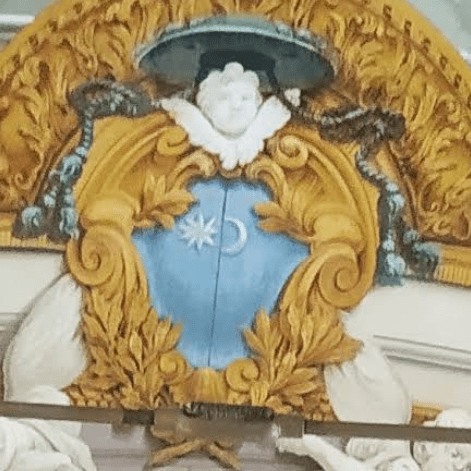

In 1714, Alessandro A. placed a memorial slab in the church of San Marcello al Corso to his uncle marquis Carlo Vitelli, who we could not find in Litta’s Famiglie celebri[3], thus we are unsure about his relationship with the illustrious family from Citta di Castello, although Valesio stated they belonged to the line of Terni. The name of Chiara, his sister and mother of Alessandro, can be traced from the record of a miracle[4] outside Viterbo, which saved her daughter, Teresa.
We could know that Giovanni Felice Abbati, marquis, owned the estate of Fonte di Papa[5], near Monterotondo, the prestigious fief alienated by Orsini to Barberini in the pontificate of Urban VIII. He owned this estate along with a certain Carlo Abbati, whose identity is also unknown. However we could assume that Giovanni Felice was somehow active in roman commercial life, from a letter he wrote to pope Clement XI (1700-21) for the contract of salt[6]. Valesio in his diary gave us more information about the fortune of this family: Felice, son of a woman nicknamed “la Verzellina” and a brass-maker surnamed Faveri, was rumored to be the illegitimate son of a notary of canonizations, from whom he took the surname and inheritance.
His children boasted high careers: Alessandro, born in Rome on 31 Jul. 1681, became referendary of both signatures in 14 Feb. 1704, a crucial step for further promotion[7], Brevium Magister around 1705 until at least 1714, Ponente of Congregation of Buon Governo around 1708-14, which deals local financial affairs in the papal states, then Auditor of Segnatura di Giustizia, the papal high court, probably from 1716 to 1724, whose responsibility was to hear criminal cases[8]. Then he passed to the court of Auditor Camerae as its lieutenant (1724-27), who acted as the ordinary judge of this major court of appeals of the papal states (and even beyond)[9]. In 1727 or 1729 he was appointed secretary of the Congregation of Council until 1731, when he became bishop of Viterbo. To curial officials of his time an appointment to bishoprics outside of Rome was considered as a “dead end”, as emphasized by Paolo Prodi[10], and he didn’t assume higher offices until his death in 1748. According to Valesio, the Abbati brothers were close to cardinal Coscia[11], which probably led to his disgrace after the death of pope Benedict XIII in 1730. His brother, Sigismondo, was conservatore of Rome in 1727, also during the pontificate of pope Orsini.
There is a certain Bianca Abbati who married marquis Androsilla, but the relationship with Alessandro and his immediate family is unclear.
Also according to Valesio [12], a certain marquis Abbati married Maria Caterina Lancetta, daughter of Antonio and grandniece of monsignor Ciriaco. Also Maddalena Lana, probably niece of monsignor Gaspare Turchi, married Pietro Abbati.
The Second Abbati family, who came from Pesaro, boasted kinship with pope Clement XI, and obtained high places during his pontificate.
Fabio Abbati Olivieri, son of Giulia Albani and Gian Andrea Abbati, was the cousin of pope Clement XI Albani. His nephew by Margherita Baviera and Malatesta, his brother, was Giovanni Francesco A., who was also promoted to high offices in mid-eighteenth century. A distant cousin of Fabio, Francesco A., became bishop of Rieti[13]. They were also related to the Baldassini family.
Acciauoli
The early history of this prominent florentine family is here. Ottaviano A. was conservatore in 1644, and his son Niccolo became Auditor of Camera, and was created cardinal in 1669. He was suggested papabile in 1691, as a candidate of Chigi faction[14]. The next family cardinal would be Filippo, grandnephew of Niccolo, whose father, another Ottaviano (or Ottavio) was conservatore in 1715.
Accolti
This family of humanists and jurists came from Arezzo, which boasted cardinals. They obtained titles from the pope, and went extinct in 1699.
Accoramboni
There are also at least two unrelated Accoramboni families in Rome: The first one came from Gubbio, and the second one originated near Spoleto.
At least four members of Accoramboni di Gubbio held the office of conservatore of Rome, and a brief family tree is reconstructed here[15]:

Girolamo (1469-1537), a physician from Gubbio, became the papal archiater, whose son Fabio studied law in Padua[16]. Another son Claudio married into the roman gentry: his wife Tarquinia came from a family which established themselves in Rome since fifteenth century. They had several children, including Vittoria, who was renowned by her adventures and her affair with Paolo Giordano Orsini, duke of Bracciano[17]. Among her brothers, Ottavio became bishop of Fossombrone and archbishop of Urbino, also collector in Portugal, while Mario was accepted in the entourage of cardinal Luigi d’Este[18], and became conservatore of Rome in 1601. Mario married Teodora Vannini, noblewoman from Gubbio, and later they bought the palace of cardinal Girolamo Rusticucci in rione Borgo.
In the church of San Andrea delle Fratte in Rome we are able to admire their family chapel, adorned by two cameo reliefs of family prelates. Among them two were born from Teodora Vannini and Mario Accoramboni. Ottavio, concealed behind his uncle in the oval frame, was governor of Cesena and died in 1637, and his brother Cinzio was Abbreviator de parco maiore and governor of Camerino, where he died in 1622[19]. Their sister, Maria Isabella, bequeathed a sum of money to the fathers of Santa Maria in Traspontina, whose church stand in close proximity to the family palace[20].
The next generation was born from Angelica Petroni, roman patrician, and Fabio Accoramboni. The integration of this family into the roman patriciate was proved by another marriage, that of their daughter, Anna Maria, to Giacinto del Bufalo. Her brother Roberto, after becoming referendary of both signatures in the footstep of his uncles, died in Ferrara in 1662 as Vice-legate there. Descendants of the family further emancipated municipal government, and intermarried with both roman nobles like del Drago and provincial ones with tight link with the capital, like Paolucci.
Among their properties, a vineyard (vigna) in via Nomentana, which came from the Lanci family, was bought by cardinal Albani to construct the villa Albani (now villa Albani Torlonia).
Another Accoramboni family came from Preci, near Spoleto, where Giuseppe, born in 1672 to poor parents[21], became a successful lawyer in Rome later in his life. Auditor of Ansaldo Ansaldi, famed jurist, and later went under the protection of cardinal Michel-angelo Conti, who would become pope Innocent XIII in 1721. After which his career flourished, and eventually became cardinal in 1728. His nephew, Ignazio A., a councilor of Augustus, king of Poland, placed his tombstone in the church of San Ignazio in Rome.
Agucchi
This bolognese noble family was recorded by Dolfi, and boasted a cardinal, Girolamo. His brother, Giovanni Battista A., was secretary of Gregory XV and nuncio to Venice under Urban VIII, also famous for his treatise on art. They probably inherited the Clavarini family of Rome through a marriage between Caterina Gozzadini and Pietro Clavarini in 1519, and boasted a conservatore, Fabio, in 1717[22]. This Fabio was also the heir of senator of Bologna Giuseppe Foscarari.
Alaleoni
Archival records of this family is rather obscure, although they had two conservatori, a priore, and two papal master of ceremonies in early Seicento, and constructed several chapels in roman churches. Paolo Alaleoni Branca (ca.1551-1643) was papal master of ceremonies from 1582 to 1638, whose abdication was probably related to the Eggenberg affair[23], while Fabio (Febo) and his son Flavio were conservatori in 1612, 1619 and 1634. Also a Giovanni Battista Alaleone was master of ceremonies in 1621.
Albani
The Albani family came to Rome in early seventeenth century, where Orazio, was secretary of justice to Francesco Maria II, duke of Urbino, and participated the negotiation of devolving the duchy into the papal states. His favor from pope Urban VIII led to his appointment as senator of Rome in 1633, and laid the foundation of fortune for next generations. His son Annibale was custodian and prefect of Vatican library, whose tombstone we can find in the church of Santa Maria in Trastevere. His grandson Giovanni Francesco was elected pope Clement XI in 1700 after a successful career in roman curia[24]. The reforming climate made him hesitate to engage in large scale nepotism, but he did made his nephew Annibale cardinal, and both Annibale and Alessandro secretary of memorials, which dealt with papal favors and the clientele network[25]. Also the family bought Soriano al Cimino in 1715 from the Altemps, another papal family. The Mattei palace in quattro fontane was bought by Alessandro Albani in 1721 at the price of 23000 scudi.
They were not to be confused with the Albani family of Bergamo, to which another cardinal, Giovanni Girolamo, belonged.
Alberi
Also spelled Alveri. The branch of Castel Romano can be partly reconstructed as:
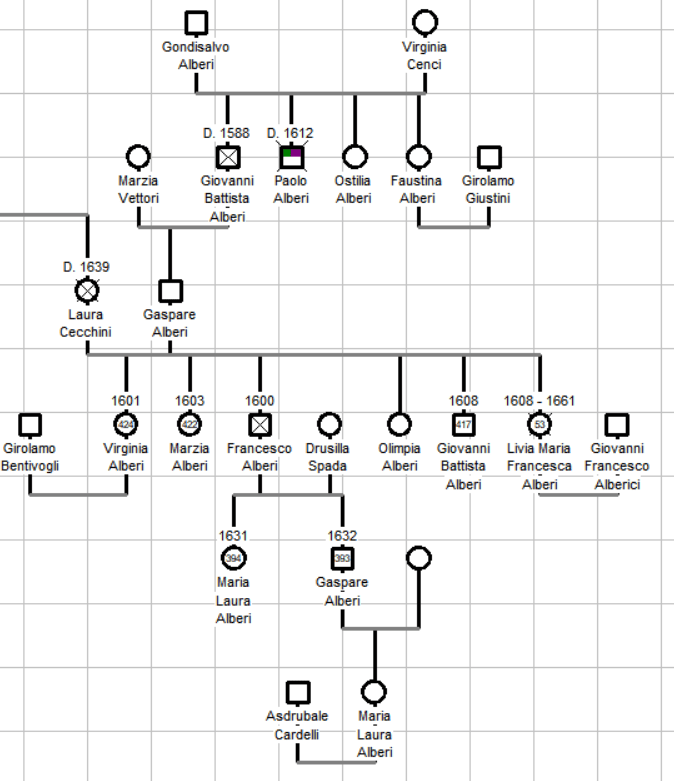
This family came from Spain, and arrived at Rome only in sixteenth century. They bought Castel Romano from the hospital of Santo Spirito in 1568, and sold it to Sacchetti in 1660. Paolo Alberi was referendare of both signatures and archbishop of Ragusa from 1588 to 1591, and Laura Cecchini, who married Gaspare Alberi, was the sister of cardinal Domenico Cecchini, datary of pope Innocent X. Giovanni Battista was conservatore in 1584, his son Gaspare was priore in 1608, and the younger Gaspare would became conservatore in 1675. Gaspare junior was an erudite, who wrote Roma in ogni Stato (see note 15), an important guide to art and history in seventeenth century Rome. Maria Laura, only child of Gaspare junior, married Asdrubale Cardelli, and the family archive now could be found in the Cardelli archives.[26]
A certain Maria Elena Alberi, a nun of Tor de’Specchi, was offered a dedication by Bonaventura Tondi in his L’Oliveto illustrato.
Another branch of this family, that of Pietro and Papirio, bought Cervelletta from Sforza in 1595, and sold it to Borghese in 1627[27].
They had a palace in rione Ponte, who sold it to Ruiz family in early seventeenth century, and later went into the possession of Bardi, then Corsini, then Sacripante family. The palace in rione Trevi was sold to Molara family before 1747, and they also had a house in rione Colonna, mentioned as property of Maria Laura, along with a tavern.
Alberici
The surname Alberici is common, and with some orthographic errors they are easy to be confused with Alberini or Alberizzi. I could only reconstruct two lines of Alberici conservatori, those of Bartolomeo and Giovanni Francesco.
Bartolomeo, who married Orotizia Mattei in 1571, is of unknown extraction, and Marcantonio, several times Caporione, seems to be a relative. Orotizia probably belonged to the Trastevere branch of Mattei family.
Giovanni Francesco, on the other hand, is better documented. He was the son of Margherita Boni of Florence, and Pirro Alberici of Orvieto[28]. His tutor was Giovanni Benini, titular archbishop of Hadrianopolis and cleric of Camera, who would became governor of Rome in 1623. They probably lived next to each other, as they both rented the Ricci palace in 1636 [29]. Born around 1610, he married Livia Alberi in 22 Jan. 1628, with a dowry of 11000 scudi[30]. He had a sister Costanza, who married Vincenzo Rossi, and a son named Pirro. A certain Giuseppe di Pirro was born in 1672, and married Maria Maddalena Maccarani, roman noble. Also we know that Maria Maddalena Maccarani rented a house near Sant’Andrea della Valle from Orazio Alberini Cianti in 1702[31]. Among their children only Costanza and Pirro were known. The marriage between Costanza and a Pandolfi of Orvieto brought the Alberici surname to that family, and among their descendants, Francesco would become cardinal in 1831[32]. Pirro (1700-1750) entered the prelature: He pronounced an oration in front of Clement XI in 1719, became VSR probably after 1734, Governor of Todi and Fabriano, Ponente of Sacra Consulta, finally cleric of Camera in 1750[33]. The Villa Alberici, which later went to the Penitentiary, belonged to this branch[34].
Alberini
The Alberini family was classified by Ferraro as old patrician[35]: undeniably their presence in Rome can be dated since fourteenth century. Numerous members of the family held high capitoline offices, including thirteen conservatori. A detailed description of family members can be seen here. The family was eventually inherited by the Cianti.
Albertoni
See: Paluzzi
[1]Weber, Christoph. Die päpstlichen Referendare 1566-1809: Chronologie und Prosopographie. Germany: Anton Hiersemann, 2003, 831.
[2]On the vault of Chiesa di San Giovanni Battista, Viterbo.
[3]Famiglie celebri di Italia. Vitelli di Città di Castello / P. Litta | Gallica
[4]Torelli, Nicolo Maria. Miracoli della Madona della Quercia di Viterbo e sua istoria. Con nuovo ordine, ed aggiunta del Padre Nicolo’ Maria Torelli. Italy: presso Andrea Poletti, 1725, 288.
[5]Weber 2003, 831.
[6]Lettera di Giovanni Felice Abbati a Clemente XI (1700-1721)
[7]Jamme, Armand., Poncet, Olivier. Offices et papauté (XIVe-XVIIe siècle): Charges, hommes, destins. Italy: Publications de l’École française de Rome, 2013, 565-591.
[8]ibid., 569.
[9]Cicerchia, Andrea. Giuristi al servizio del Papa: il tribunale dell’auditor Camerae nella giustizia pontificia di età moderna. Italy: Archivio segreto vaticano, 2016. for detailed research on this tribune; also Moroni, Gaetano. Dizionario di erudizione storico-ecclesiastica da S. Pietro sino ai nostri giorni …. Italy: Emiliana, 1856, 147-48.
[10]Tabacchi, Stefano. Il Buon Governo: Le finanze locali nello Stato della Chiesa (secoli XVI-XVIII). Italy: Viella Libreria Editrice, 2011, 190.
[11]Valesio, Francesco. Diario di Roma. Italy: Longanesi, 1977, volume IV, 599.
[12]ibid., 623. The name of the bride can be assumed through Foglio di Foligno. N.p.: n.p., (n.d.), 26 Aprile 1732.
[13]Weber 2003, 831.
[14]A detailed analysis on document is in: CSUN
[15]Sources and bibliography: Paviolo, Maria Gemma. I Testamenti Dei Cardinali: Giuseppe Accoramboni (1672-1747). United States: Lulu.com, 2017.; Paviolo, Maria Gemma. I Testamenti Dei Cardinali: Fabrizio Paolucci (1651-1726). United States: Lulu.com, 2017.; Alveri, Gasparo. Roma in ogni stato alla santità di N.S. Alessandro settimo. Di Gasparo Alueri parte prima [-seconda]. ..: Della Roma in ogni stato di Gasparo Alueri parte seconda. Nella quale distinta in venti giornate si tratta del sito di essa più moderno, delle chiese che per il detto camino si trouano, con le loro fondationi, … Con vn indice copiosissimo di tutte le cose notabili, che si contengono in questa seconda parte. 2. N.p.: nella stamperia di Fabio di Falco, 1664.; Weber, Christoph, e Oscar Mischiati. Legati e governatori dello Stato pontificio, 1550-1809. Roma: Ministero per i beni culturali e ambientali, Ufficio centrale per i beni archivistici, 1994.
[16]”Gerolamo Accoramboni”, in Dizionario Biografico degli Italiani, volume 1, 1960
[17]Leonard, Amy E.. Masculinities, Violence, Childhood. N.p.: University Press Copublishing Division, 2010, 357.
[18]Bizzarini, Marco., Chater, James. Luca Marenzio: The Career of a Musician Between the Renaissance and the Counter-Reformation. United Kingdom: Taylor & Francis, 2017, 103.
[19]Weber 2003, 384.
[20]Forcella, Vincenzo. Iscrizioni delle chiese e d’altri edificii di Roma dal secolo XI fino ai giorni nostri. Italy: Tip. delle scienze matematiche e fisiche, 1869, volume I, 485.
[21]Weber 2003, 384.; Cardella, Lorenzo., Memorie storiche de’ cardinali della santa romana Chiesa scritte da Lorenzo Cardella parroco de’ SS. Vincenzo, ed Anastasio alla Regola in Roma. Tomo primo [-nono]: 8. N.p.: n.p., 1794, 238.
[22]Guidicini, Giuseppe. Cose notabili della città di Bologna: ossia, Storia cronologica de’ suoi stabili sacri, pubblici e privati. Italy: Forni, 1869, 20.
[23]Rietbergen, P. J. A. N.. Power and Religion in Baroque Rome: Barberini Cultural Policies. Germany: Brill, 2006, 194.
[24]On Clement XI and his family, see: Clement XI – Encyclopedia – Treccani
[25]On nepotism, see: Menniti Ippolito, Antonio. Il tramonto della Curia nepotista. Italy: Viella, 2008, 154.
[26]Cicchetti, Angelo., Mordenti, Raul. I libri di famiglia in Italia. Italy: Edizioni di storia e letteratura, 1985, 193.
[27]Ferraro, Richard Joseph. The Nobility of Rome, 1560-1700: A Study of Its Composition, Wealth, and Investments. N.p.: University of Wisconsin–Madison, 1994, 725.
[28]=Forcella, Vincenzo. Iscrizioni delle chiese e d’altri edificii di Roma dal secolo XI fino ai giorni nostri. Italy: Tip. delle scienze matematiche e fisiche, 1876, volume VII, 21. Pirro bought several places of monti, the bond issued by papal states, in 1604.
[29]Ferraro 1994, 426.
[30]Cicchetti, Angelo., Mordenti, Raul, 1985, 201.
 浮槎
浮槎 
留下评论